Summary
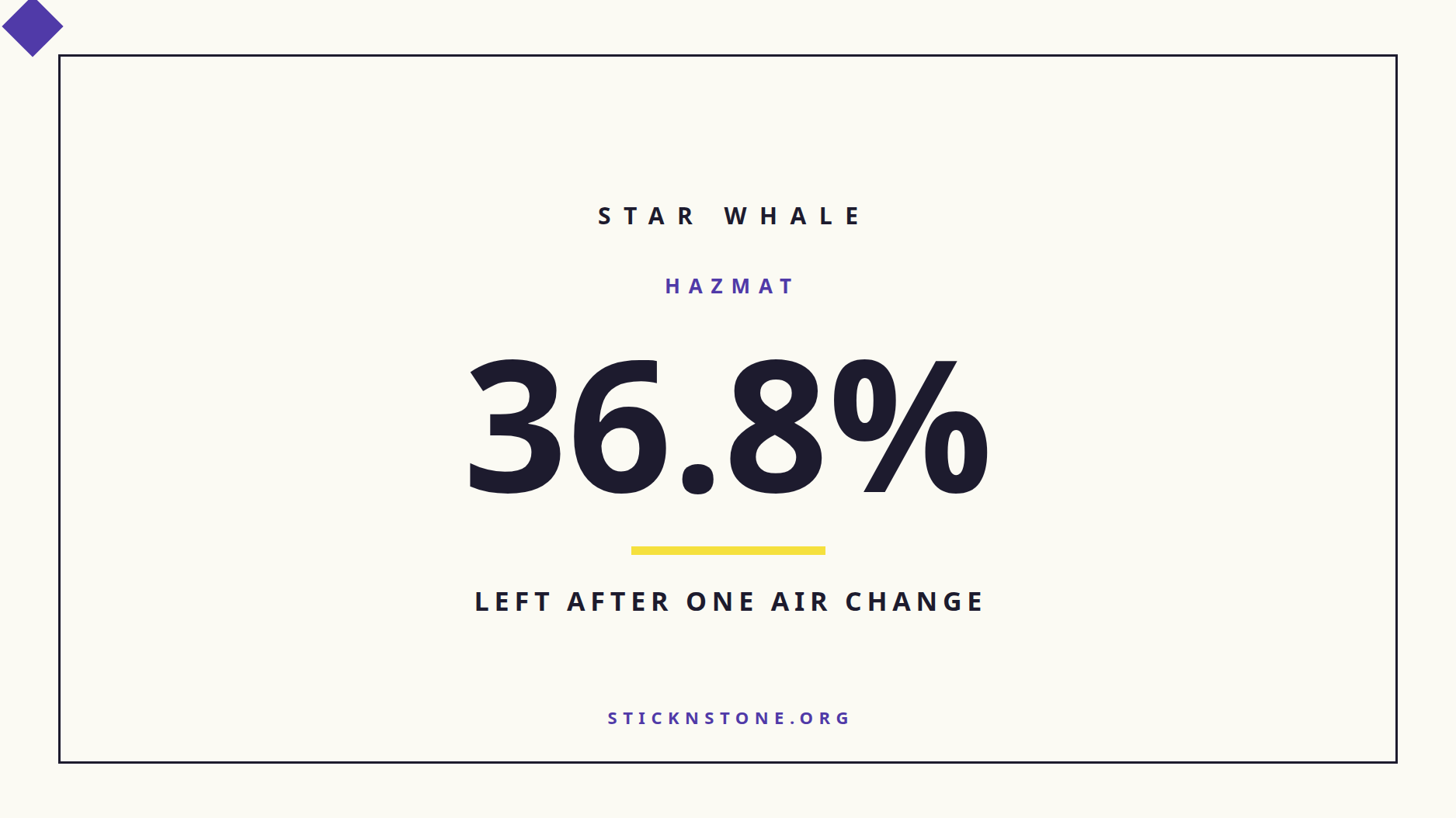
One number in ventilation math never sits right: 36.8 percent remains after a single air change.
You have pushed a whole room volume of air out. Why is a third of the contaminant still there, and why exactly 36.8?
There is one reason. The clean air that came in mixes with the contaminated air and leaves with it. A fan cannot pick out only the dirty molecules.
Slice that process finely enough and the constant e falls out on its own.
What ACH actually is
ACH is air changes per hour. The definition is one division.
\mathrm{ACH} = \frac{Q}{V}
Q is exhaust flow (m³/h) and V is room volume (m³).
For a 60 m³ room with a 600 m³/h fan:
\mathrm{ACH} = \frac{600}{60} = 10\ \mathrm{h^{-1}}
Moving one room volume of 60 m³ takes 60 ÷ 600 = 0.1 hours, which is 6 minutes.
That part is easy. The next part is not.
You moved 60 m³, so why is the old air still here?
If air were pushed out like a piston — new air entering on one side, displacing old air ahead of it — it would all leave.
But the usual ACH model does not assume that. It assumes perfect mixing.
The moment clean air enters, it mixes with the contaminated air. The fan then pulls out that mixture. So the fan is also throwing away air it just brought in.
Every bit of clean air discarded is contaminant that stays behind.
Counting it in slices
Instead of removing one room volume all at once, remove it in ten steps — 10 percent each time, with complete mixing after each step.
| Step | Fraction remaining |
|---|---|
| 1 | 100% × 0.9 = 90% |
| 2 | 90% × 0.9 = 81% |
| 3 | 81% × 0.9 = 72.9% |
| … | … |
| 10 | 0.9¹⁰ ≈ 34.9% |
Removed in one go it would have been zero. Removed in ten steps, 34.9 percent survives.
Slice it finer:
\left(1-\tfrac{1}{10}\right)^{10} = 0.349 \quad\;\; \left(1-\tfrac{1}{100}\right)^{100} = 0.366 \quad\;\; \left(1-\tfrac{1}{1000}\right)^{1000} = 0.3677
The finer the slices, the closer it creeps to 0.367879…, which is the reciprocal of e.
\lim_{n\to\infty}\left(1-\frac{1}{n}\right)^{n} = e^{-1} = 0.367879\ldots
Real ventilation is continuous, not stepwise. So the infinitely sliced version is the right one, and 36.8 percent is what remains.
Nobody inserted the e
Seeing e in a ventilation formula makes it look like an arbitrary constant dropped in. It is not.
Calculate “remove a fixed proportion of whatever is left, continuously” and e appears by itself. Radioactive decay, compound interest and drug elimination all share the shape.
Ventilation is not special. Any process with that shape produces e.
Deriving it from mass balance
The same answer comes out of a balance equation.
Total contaminant mass in the room is concentration times volume.
M = C \cdot V
In a short interval the fan removes Q·dt of air carrying C·Q·dt of contaminant, and the room loses exactly that.
V\,dC = -\,C\,Q\,dt \;\;\Rightarrow\;\; \frac{dC}{dt} = -\frac{Q}{V}\,C = -\mathrm{ACH}\cdot C
What the equation says is one sentence. The rate of decrease is proportional to what is left.
High concentration means a lot leaves; low concentration means little leaves. So it falls as a curve, not a line. Solving gives:
C(t) = C_0\, e^{-\mathrm{ACH}\cdot t}
How much is left after several changes
With cumulative changes N = ACH × t, the residual is a power of e.
| Cumulative changes | Remaining | Removed |
|---|---|---|
| 1 ACH | 36.8% | 63.2% |
| 2 ACH | 13.5% | 86.5% |
| 3 ACH | 4.98% | 95.0% |
| 4 ACH | 1.83% | 98.2% |
| 5 ACH | 0.674% | 99.3% |
| 6 ACH | 0.248% | 99.8% |
In a room at ACH 10, one change is 6 minutes, so three changes is 18 minutes and five is 30.
Each additional change removes 63 percent of whatever remains. Fast at first, slow later.
The assumptions attached
The formula holds under ideal conditions. Real rooms break them one by one.
- Air in the room is always perfectly mixed
- The fan delivers its nominal flow
- Incoming outside air is essentially clean
- No contaminant returns from adjacent spaces
- No new contaminant is being generated
That last one matters most.
With a source still present, it never reaches zero
If liquid is still on the floor evaporating, the fan removes while the source replenishes. With a generation rate G (mg/h), the balance gains a term.
V\frac{dC}{dt} = G – Q\,C
Run it long enough and it settles where generation equals removal.
G = Q\,C \;\;\Rightarrow\;\; C_{\infty} = \frac{G}{Q}
So while the source lives, concentration stalls at G/Q no matter how long the fan runs. A bigger fan lowers that floor; it does not reach zero.
Which fixes the order of operations. Remove the source first. Ventilate second.
Do not end ventilation on a clock
“ACH 10, ran it 30 minutes, so 99.3 percent removed” is a dangerous way to finish. Several things separate the arithmetic from the room.
- Duct resistance can put actual flow below nominal
- Gaps around the fan create short circuiting, recycling outside air instead of room air
- Under furniture and in floor cracks the air barely moves
- If a source remains, you are pinned at G/Q
So split the roles.
| ACH calculation | Actual measurement |
|---|---|
| To estimate how long | To decide whether it is safe |
Start with the calculation, finish with the meter.
What I took away
- ACH is exhaust flow over room volume; one change is the time to move one room volume
- 36.8 percent remains because incoming clean air mixes in and leaves again
- Sliced infinitely, (1 − 1/n)ⁿ converges to 1/e. Nobody inserted the e
- Decay is proportional to what remains, which is exactly what makes it exponential
- With a live source, concentration stalls at G/Q. Ventilation alone does not solve it
- End ventilation on a measurement, not a clock
In one line: ventilation does not destroy a contaminant. It moves it outside.
On the strength of this evidence
These relations are the standard result for a well-mixed single-zone model, common to industrial ventilation and indoor air quality texts. The figures here I computed directly.
- ACGIH, Industrial Ventilation: A Manual of Recommended Practice : airflow sizing and local exhaust design
- ASHRAE Handbook — Fundamentals : indoor contaminant behavior and ventilation models
- US EPA, Indoor Air Quality : basic concepts of indoor contaminants and ventilation
⚠ Field application shifts with how badly the well-mixed assumption fails, the fan’s measured flow, and whether a source remains. Do not judge safety from this equation alone.
Leave a Reply