Summary
- Reading my local usage logs with
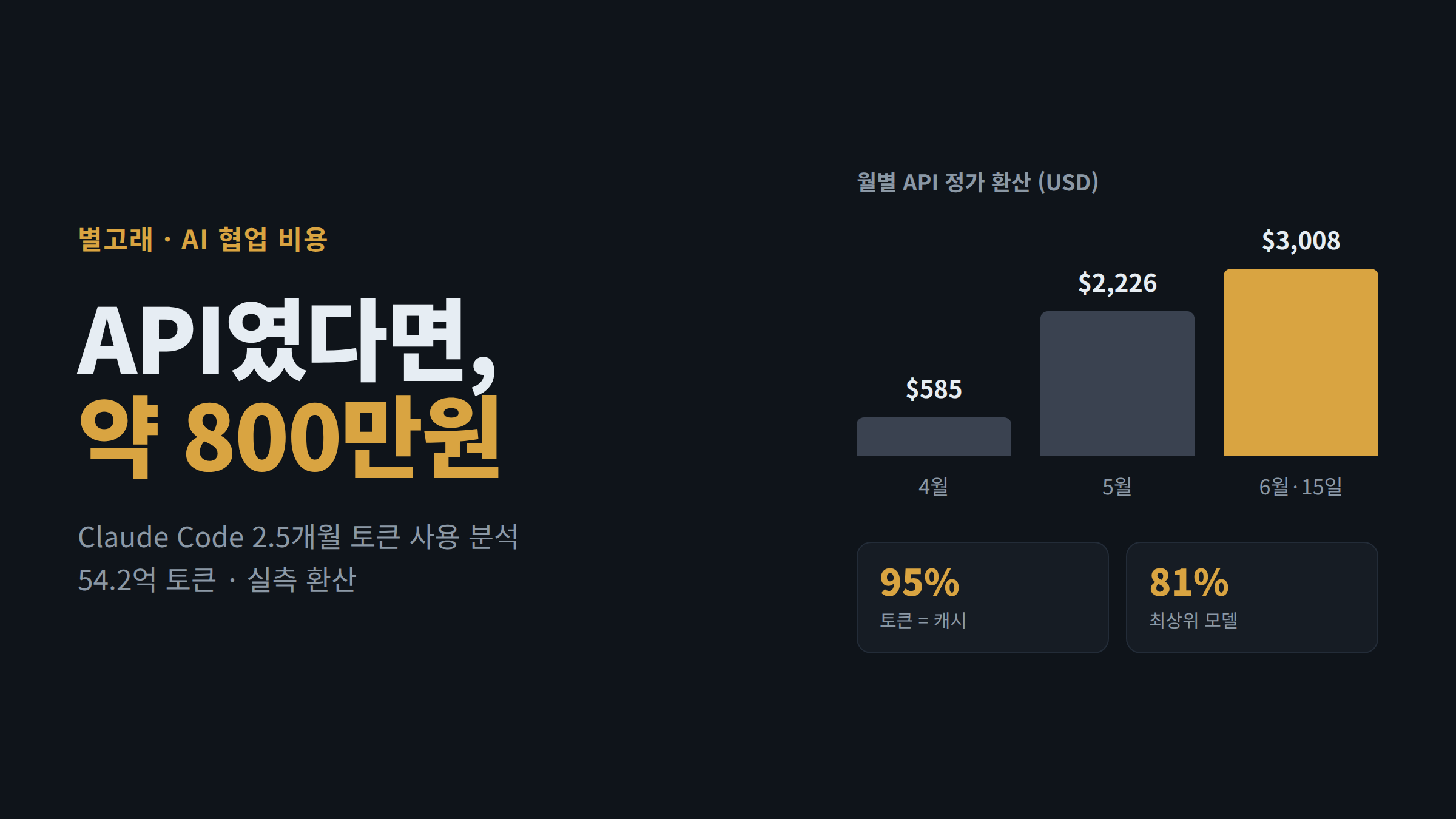
ccusage, I traded 5.42 billion tokens with AI over ~2.5 months (46 active days). - Priced at pay-as-you-go API rates, that comes to about $5,819. Monthly: $585 (Apr) → $2,226 (May) → $3,008 (first half of June).
- But 95% of those tokens were cache reuse, not fresh input. Cache is what makes long-term AI collaboration affordable.
- A list-price estimate is not an invoice — run on a flat subscription, the gap is your savings.
What I measured, and how
AI coding tools log the token count of every message exchanged, locally. Read that log with the open-source tool ccusage and it multiplies by each model’s price table to show “what this would cost on the API.”
It is one command. npx ccusage@latest prints usage and cost per day and per model. I pulled out the grand total and the per-model breakdown.
One caveat: this figure is at pay-as-you-go API list price. I actually ran on a flat subscription, so the number is a hypothetical invoice — “if I had paid per token.”
Result: $5,819 at API list price over 2.5 months
Across 46 active days, the list-price total was $5,819. Almost all of it was one model family; a brief detour into another model rounded to zero ($0.28).
| Model | API list price | Tokens |
|---|---|---|
| Opus 4.8 | $2,391.72 | 2.17B |
| Opus 4.7 | $2,330.44 | 2.41B |
| Fable 5 | $884.16 | 0.46B |
| Sonnet 4.6 | $209.22 | 0.35B |
| Haiku 4.5 | $3.79 | 0.02B |
| Total | $5,819 | 5.42B |
The monthly trend is more telling: $585 in April, $2,226 in May, and $3,008 in just the first half of June.
June passed May before the month was even half over. As the work grows, tokens compound.
Insight 1 — 95% of tokens were cache
Of 5.42B tokens, 5.15B (95%) were cache reuse, not freshly purchased input. That did not inflate the bill — it held it down.
Every conversation, I have to re-feed long context (work rules, project memory, instruction docs) to the AI. Buying that fresh every turn would explode the token count.
Cache works like a fridge: you reheat yesterday’s soup instead of cooking it from scratch each time. A cache read costs about one-tenth of fresh input, so reusing the same context ten times costs roughly once.
Without cache, that $5,819 would have been far larger. The longer the collaboration, the more cache design is cost design.
Insight 2 — 81% of the cost was the top model
Of $5,819, about $4,722 (81%) came from the most expensive Opus tier. Move the same work to a cheaper model and the cost changes by an order of magnitude.
The contrast is stark. The smallest model, Haiku, processed 20.7M tokens for just $3.79. The same volume on Opus would cost dozens of times more.
You can drive a nail with a wrench, but if you have a screwdriver, use it. Hard reasoning goes to the top model; simple, high-volume repetition goes to a small one. Match the model to the task and you get the same result far cheaper.
Insight 3 — a list-price estimate is not an invoice
$5,819 is a “what-if pay-as-you-go” figure, not money I actually paid. Run that much work on a flat subscription and the difference is effectively your savings.
This is the cost structure of using AI as a full-time colleague rather than a tool. Metered pricing rises linearly with use; a flat plan is like a buffet — the more you eat, the cheaper each plate.
It is not free, of course. The point is not the size of the number — it is that I measured the usage pattern. Once you measure, you can see where to cut, as in insights 1 and 2.
Try it yourself
Curious about your own usage? It is one line. Run npx ccusage@latest in a terminal and it reads your local logs to compute the cost.
The data stays local; nothing leaves your machine. Slice it by model and by day, and it quickly shows where tokens are leaking.
Sources
The numbers in this post come from the following tools and docs.
Leave a Reply